
 Impact Windows
 Impact Doors
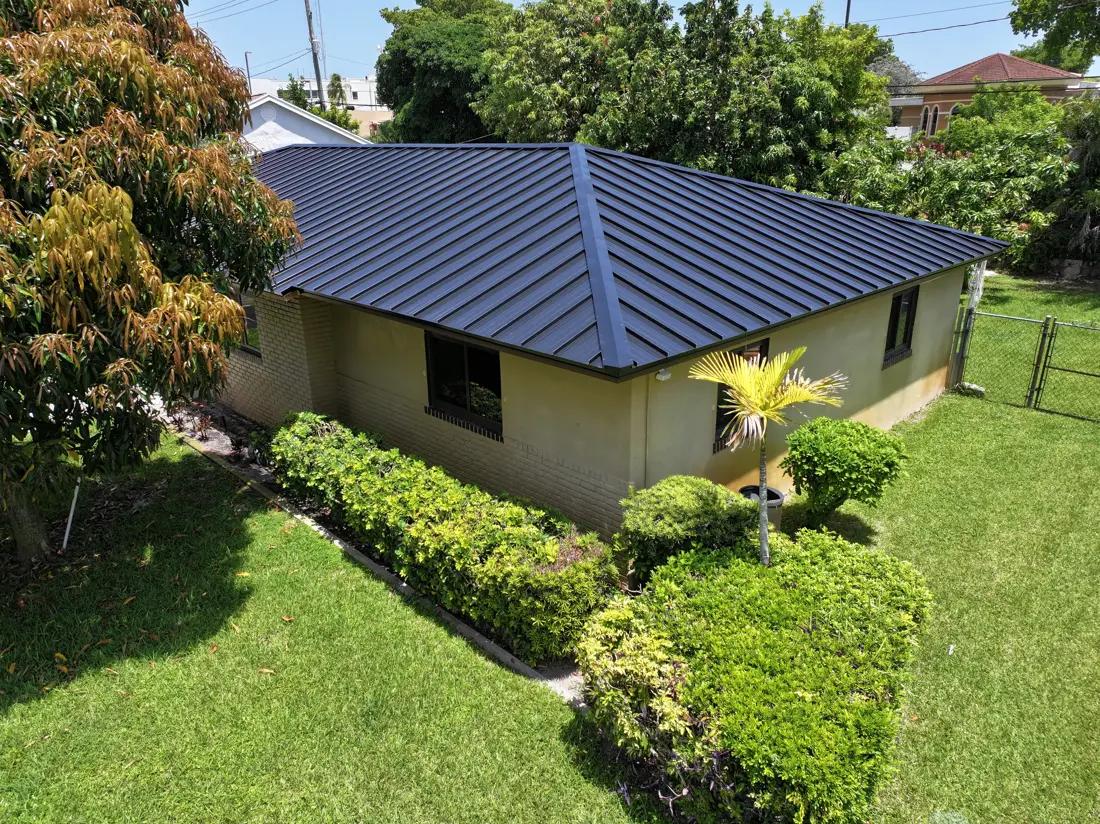 Roofing

Most of a roof is easy to keep dry. The hard parts are the places where the roof stops, changes direction, meets a wall or has a pipe coming through it. Those spots are handled with metal and membrane pieces called flashing, and when a South Florida roof leaks, that’s often where the water got in. Florida’s code spells out where flashing is required: wherever a roof meets a wall, wherever the slope or direction changes, and around every opening.
FEMA’s coastal construction guide says it directly: poor flashing performance and the water intrusion that follows are a common problem on coastal homes.
Drip edge
Drip edge is the bent metal strip along the eaves and the sloped gable edges. It carries water off the roof edge and away from the fascia board, and it fastens down the edge of the roof, which is where wind starts to work on it.
For shingle roofs, the Florida Building Code, Residential gets specific:
- Drip edge is required at eaves and gables.
- Pieces overlap at least 3 inches.
- At the eave it extends 1/2 inch below the sheathing and runs at least 2 inches back onto the roof.
- It goes over the underlayment, with a 4-inch band of roof cement over the flange.
- It’s nailed at most every 12 inches, tightening to every 4 inches when the design wind speed passes a set threshold or the roof is taller than 33 feet.
In Miami-Dade and Broward, the eaves have to give the edge metal a firm nailing surface, and shingles can’t hang more than 1/4 inch past it. On our contracts the drip edge is a 24-gauge, aluminum-zinc coated steel bullnose profile, and you pick its color.
Valleys
A valley is the inside corner where two roof slopes meet, and it carries the runoff from both. It’s also where leaves and dirt tend to collect.
The residential code allows a few valley linings under shingles. An open metal valley has to be at least 16 inches wide, in one of the code’s approved metals. A closed valley, with shingles running across it, can use a 36-inch-wide self-adhering membrane underneath. In the HVHZ, shingle valleys have to be metal and set in an 8-inch bed of roofing cement. Our roof contracts call for 18-inch, 24-gauge aluminum-zinc coated steel in all valleys, which is wider and heavier than the residential code’s minimum.
Where the roof meets a wall
Second-story walls, parapets and chimney chases all need flashing where the roof meets them. The code allows step flashing, where a separate bent piece goes with each course of shingles, or a continuous L-shaped flashing. One accepted method is a 4-by-4-inch metal L set in flashing cement, nailed every 6 inches on both legs, with 4-inch sealed laps that start at the bottom so each piece sheds onto the one below.
The top edge of that base flashing then needs counterflashing, a piece fastened into or onto the wall that covers it.
FEMA’s fact sheet on roof-to-wall flashing adds three habits worth asking about: a taller vertical leg on step flashing, self-adhering tape over the top of the step flashing, and never using sealant as a substitute for proper laps.
One more rule: a chimney or other penetration more than 30 inches wide needs a cricket, a small peaked section on the uphill side that splits the water around it.
Pipes, vents and skylights
Every pipe and vent is a hole in the roof. The reroofing rules say existing vent flashing, metal edging, collars and counterflashing can’t be reinstalled if they’re rusted, damaged or deteriorated. Our roof contracts replace them as a matter of course: new lead boots on the plumbing stacks and new 26-gauge metal vents. Skylights get their own line on the contract.
Tile roofs are a little different
On tile, flashing at walls and other vertical surfaces follows the tile manufacturer and the FRSA/TRI tile installation manual the code points to. The principle is the same: base flashing, counterflashing over it, laps that shed water downhill.
What you can check from the ground
- Rust streaks or loose metal along the eaves.
- Thick roof cement smeared where a roof meets a wall, often a sign of an old repair.
- Ceiling stains on an outside wall below a roof-to-wall joint.
If you see any of those, have a roofer look before the rainy season does. We do roof repairs on flashing alone, and on a full roof replacement the drip edge, valley metal, pipe boots and vents are all new. More about our systems on our roofing page, or call (786) 654-8273.


