
 Impact Windows
 Impact Doors
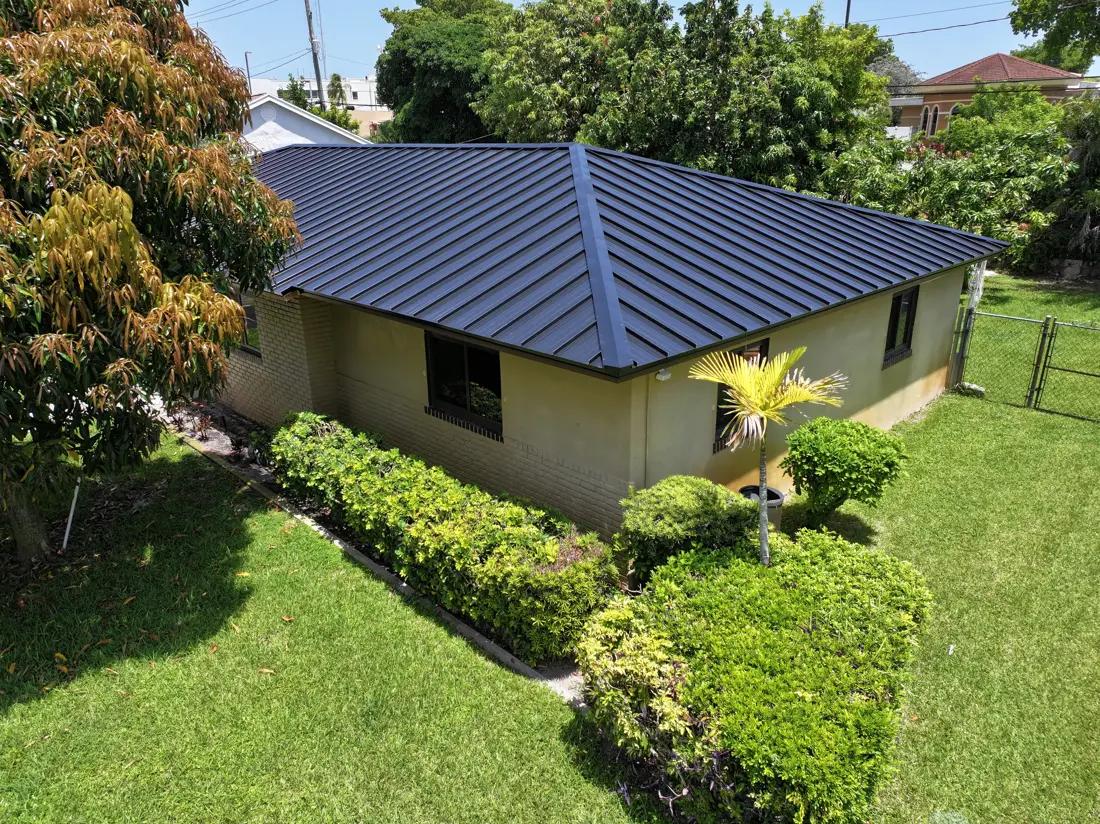 Roofing

The biggest difference is where the fasteners go. A 5V crimp panel is screwed down through its face, so every screw head sits on the outside of the roof. A standing seam panel locks to its neighbor at a raised seam, and the clip or nailing flange that holds it down is hidden under that seam. Both kinds carry Miami-Dade product approvals, so either can be permitted in hurricane country. They behave differently on low slopes, in upkeep and at the edges. The metal roof we install is standing seam.
How each panel is built
FEMA’s Home Builder’s Guide to Coastal Construction devotes Fact Sheet 7.6 to metal roofs in high-wind regions, and it sorts them into two families:
- Water-barrier panels, built to resist water even when it backs up against the seam. Their seams sit above the water line and carry sealant.
- Water-shedding panels, which rely on gravity. They need a steeper roof, typically more than 3 in 12, and an underlayment under them to catch what gets past.
FEMA lists 5V crimp with ribbed and corrugated panels as through-fastened, meaning attached with exposed fasteners. The Miami-Dade approvals for 5V panels that we’ve read call for screws with neoprene sealing washers, so each screw head carries its own seal. Standing seam panels hide the attachment, using clips or a fastening flange under the seam. The Drexel Metals 100NS panel on our roofing page snaps together at a concealed 1-inch seam without separate clips.
Slope rules in the code
The Florida Building Code, Residential sets minimum slopes by seam type:
- Lapped seams with no sealant: 3 in 12.
- Lapped seams with sealant applied in the laps: 1/2 in 12.
- Standing seam systems: 1/4 in 12.
The High-Velocity Hurricane Zone (HVHZ) rules in the Florida Building Code, Building govern Miami-Dade and Broward instead. Its table puts architectural metal panels at 2 in 12, and lets a standing seam system that passes the ASTM E2140 water leakage test go down to 1 in 12. The product approval for the specific panel sets its own limits on top of that. The panel we use lists a 3 in 12 minimum, so a nearly flat porch roof gets a different system.
What the HVHZ asks of any metal panel
Whether it’s 5V or standing seam, a metal roof in Miami-Dade or Broward has to clear the same bar:
- Steel panels at least 26 gauge with G-90 coating, or aluminum at least 0.025 inch thick.
- A product approval covering the whole system: panel, underlayment and accessories.
- Wind uplift testing under TAS 125.
- Panels that can take foot traffic without damage, ending no more than 1 inch past the eave.
- Every intersection flashed in metal.
The steel panels on our metal jobs are 24 gauge, thicker than that minimum, since a lower gauge number means heavier steel.
What FEMA found after hurricanes
FEMA’s fact sheet draws lessons for both types from what investigators found after hurricanes.
For exposed-fastener panels like 5V, it names an advantage: after installation it’s easy to count the screws, and if there aren’t enough, adding more is simple. One failure it documents was 5V crimp laid over an old shingle roof and screwed to wood strips whose nails into the sheathing were spaced too far apart. The strips let go, and the panels went with them.
For concealed-clip panels in high-wind areas like ours, FEMA recommends at least two clips along the eaves, ridges and hips, with the first within 2 to 3 inches of the eave.
A few recommendations apply to any metal roof near the coast:
- Fasten hip, ridge and rake trim with exposed screws in two rows, spaced roughly 3 to 6 inches apart.
- Within 3,000 feet of the ocean, use 300 series stainless clips and fasteners.
- If the underlayment is self-adhering, use one made for metal roofs, which resists softening and flowing in high heat.
Over the old roof or down to the deck?
Outside the HVHZ, the residential code lets a standing seam system that carries its loads straight to the framing go over an existing roof without a tear-off. Our metal jobs start with removing the old roof to the plywood or board deck anyway, so the deck can be inspected, repaired and re-nailed before the self-adhered underlayment goes down.
If you’re comparing quotes, ask each contractor which panel it is, what gauge, how it’s fastened at the eaves and hips, and for the product approval number. You can see how we build a metal roof on our hurricane roofing page, or call (786) 654-8273.


